At 12:02 PM on Thursday 19 June 2025, Guernsey Coastguard received a distress call via VHF radio from a 12-metre motor cruiser located to the east of Sark. The vessel was taking on water, with smoke emanating from the engine bay. Although the crew had secured the boat to a mooring buoy, they were unable to stem the ingress of water. In response, Guernsey Coastguard immediately paged the St Peter Port Lifeboat at 12:05 PM. The Lifeboat launched from Pierheads at 12:18 PM while the Coastguard maintained communication with the vessel. The situation continued to deteriorate, prompting the crew to prepare for evacuation into a dinghy. A nearby vessel rendered timely assistance, safely retrieving one of the crew members before the Lifeboat arrived on scene at 12:37 PM and recovered the remaining crew member. Three Lifeboat crew members were then transferred aboard the casualty vessel along with a salvage pump to begin dewatering operations. Recognizing the extent of the flooding, a second salvage pump was dispatched from Sark. The Lifeboat crew successfully identified the source of the water ingress and completed a temporary repair. In addition, an electrical issue—responsible for the smoke—was located and rectified. At 1:41 PM, the Lifeboat began towing the damaged vessel back to St Peter Port, accompanied by the Sarnia workboat to provide additional support if required. Both vessels arrived safely in harbour at 3:33 PM, where Harbour staff promptly craned the casualty vessel out of the water for inspection. Search Mission Coordinator Simon Granger commended the efforts of all involved: “This was an excellent response by numerous parties which resulted in the rescue of the two crew members. The swift actions of the Lifeboat Crew, assisted by the Sark Harbourmaster and the Sarnia Workboat, were instrumental in saving the boat. Our thanks also go to the first local vessel on the scene, which safely took one of the stricken vessel’s crew members off prior to the Lifeboat’s arrival.”
colin
Multi-Agency Search for Person In The Water At Cobo Bay
Young Person Rescued from the Sea at Cobo Bay At approximately 6:30pm yesterday evening (23rd April 2025), the Joint Emergency Services Control Centre (JESCC) received a 999 call from members of the public reporting a young person in distress in the water at the north end of Cobo Bay, on Guernsey’s west coast. Callers stated the individual appeared to be struggling and was being rapidly swept out to sea. JESCC immediately passed the call and initial details to Guernsey Coastguard, who promptly initiated a multi-agency response. The Royal National Lifeboat Institution’s (RNLI) inshore lifeboat Harold Hobbs was paged, along with the Channel Islands Airsearch (CIAS) aircraft. A Coastguard officer from the drone unit was also deployed to the scene. The Coastguard officer arrived on scene at 6:50pm and, with the assistance of a member of the public and binoculars provided from the Coastguard vehicle, confirmed visual contact with the casualty. The member of the public maintained a watch until the drone was launched, which then provided aerial overwatch until the arrival of the IRB. At approximately 7:00pm, the RNLI inshore lifeboat reached the scene and quickly located and recovered the young person from the water. The casualty was transported to the beach at Cobo, where they were assessed by an awaiting ambulance crew. Due to the extended time spent in the water—over 90 minutes—and concerns about potential seawater ingestion, the decision was made to transport the individual to the Princess Elizabeth Hospital for further observation. The CIAS aircraft was stood down at 7:10pm, and the RNLI lifeboat returned to station by 7:42pm.
Single-Handed Sailor Rescued After Navigation Failure and Disorientation
Guernsey, 18 April 2025 – Shortly after 11:00 AM on Friday, Guernsey Coastguard received a faint and broken “MAYDAY” distress call. No additional information accompanied the call, and no other Coastguard stations picked up the transmission. Guernsey Coastguard assumed coordination of the incident and began efforts to establish contact with the casualty. After several attempts, extremely poor communication was finally established with the distressed sailor. Through the broken transmission, Coastguard officers were able to determine the vessel’s name as Dasher. The solo sailor reported that all navigation equipment onboard had failed, leaving him disoriented amid poor weather and low visibility. Fatigue further compounded his situation. At 11:28 AM, the sailor confirmed that he had a Personal Locator Beacon (PLB) onboard and was instructed to activate it. However, an immediate location fix was not obtained from the activation. At 11:49 AM, the sailor reported that he believed he was approximately 5 to 6 nautical miles north of Guernsey at the time his navigation systems failed. This provided the first search area, and both the St Peter Port All-Weather Lifeboat (ALB) Spirit of Guernsey and the Channel Islands Air Search (CIAS) aircraft Lions Pride were launched to search the area north of Guernsey. At 12:42 PM, Guernsey Coastguard was informed by the French Maritime Rescue Coordination Centre (MRCC) in Jobourg that a PLB position had been received, locating the vessel approximately 8 nautical miles west-southwest of Casquets Lighthouse. This new position was relayed to the lifeboat and air search teams, who made best speed to the location. Upon arrival, the lifeboat detected a radar target approximately 2 nautical miles north of the PLB coordinates. This was visually confirmed as the Dasher by the CIAS aircraft. By 1:00 PM, the Spirit of Guernsey arrived alongside the casualty vessel. Despite continued communication difficulties, it was quickly established that the sailor—while cold, wet, and fatigued—was uninjured. His cat was also found safe. A tow was established, and by 1:18 PM the lifeboat began the return journey to St Peter Port with Dasher secured astern. At 2:49 PM, the lifeboat crew alerted Guernsey Coastguard that Dasher appeared to be taking on water under tow. The Inshore Rescue Boat (IRB) Harold Hobbs was tasked to assist with transferring crew and a salvage pump to the vessel. The IRB launched at 3:05 PM and rendezvoused with the lifeboat and Dasher in sheltered waters north of the island. Crew and a pump were transferred to the vessel, and the tow resumed. Around 4:30 PM, the lifeboats and Dasher arrived safely in St Peter Port Harbour, where the vessel was handed over to Guernsey Marinas staff. Search Mission Coordinator Mike Harris commented: “This was a successful search and rescue operation carried out in challenging conditions. The incident highlights the vital importance of carrying Emergency Position-Indicating Radio Beacons (EPIRBs) or Personal Locator Beacons (PLBs) onboard. Although the initial signal was delayed, having a registered and functioning PLB significantly shortened the time it took to locate the vessel. We also remind all mariners to ensure their EPIRBs or PLBs are properly registered and maintained. Our sincere thanks go to the St Peter Port Lifeboat crew and the Channel Islands Air Search team for their swift and professional response.” “Guernsey Coastguard would also like to thank the owners of the yacht “Jappeloup” who kindly provided “Dasher’s” owner (and cat), with dry clothing and accommodation onboard their vessel overnight.”
Capsized Dinghy South Coast
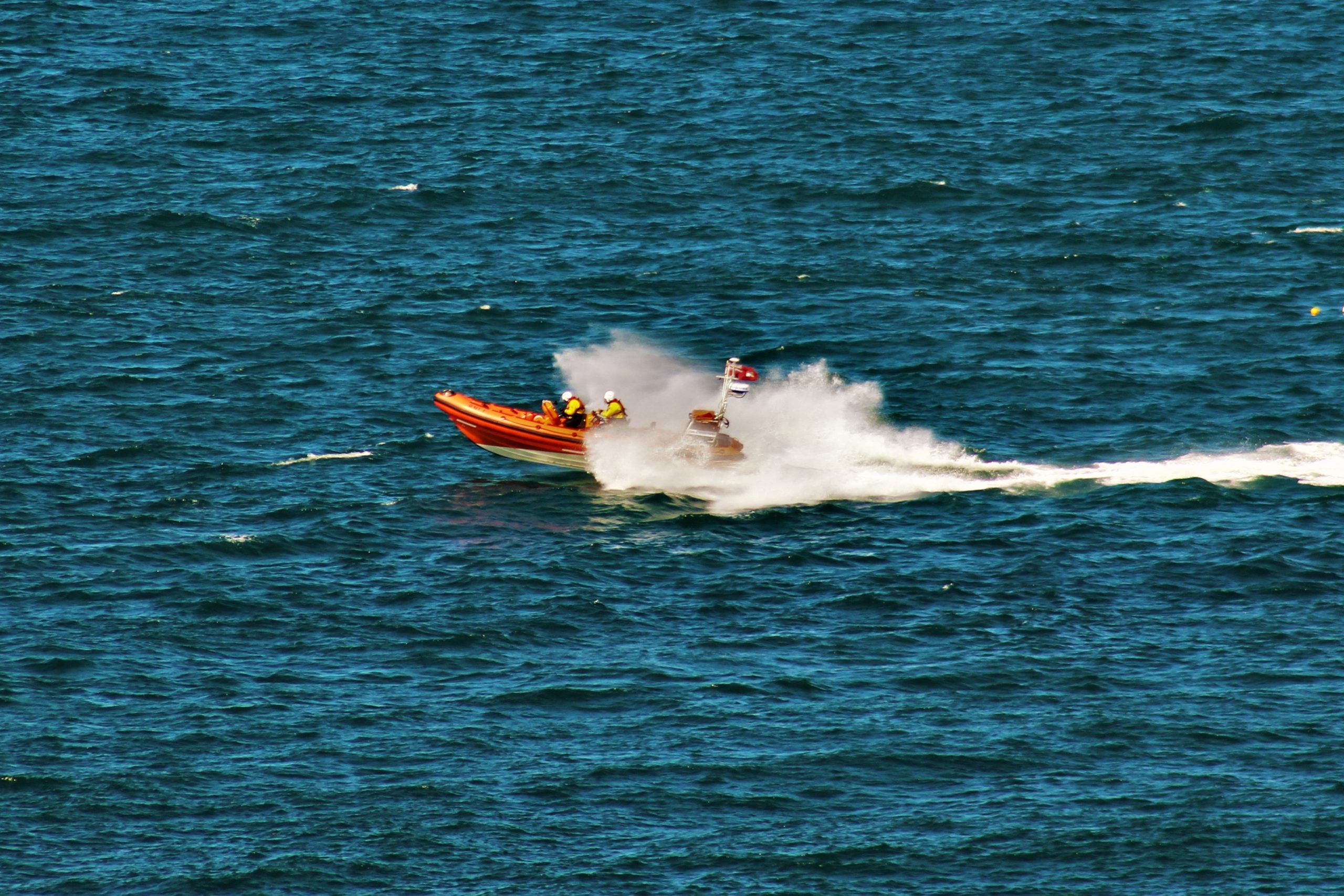
Shortly after 2:15pm on Monday 6th January, 2025, the Joint Emergency Services Control Centre
(JESCC) received a mobile telephone call from the crew of a small dinghy that had capsized south of St Martin’s Point. The dinghy was drifting in difficult wind and tide conditions with 2 people clinging to the upturned hull.
JESCC alerted Guernsey Coastguard and both St Peter Port All Weather Lifeboat and the Inshore Lifeboat were tasked to the scene. Herm Trident VI was also requested to proceed to St Martin’s Point whilst returning from Herm to Guernsey and Channel Islands Air Search was also paged to launch.
Trident VI was the first vessel on scene but was unable to locate the casualty. After a short search of the area by both Trident and the Inshore Lifeboat, the capsized dinghy and its crew were located. Both people were recovered from the water and were returned to St Peter Port by the Inshore Lifeboat. On arrival in St Peter Port, the casualties were checked over by paramedics but were otherwise uninjured.
Search Mission Coordinator James Way said: “This was a successful search and rescue operation in challenging conditions. We would like to thank the master of Trident VI for his support today as well as the volunteer crews of our Lifeboats.”
Lifeboat swap
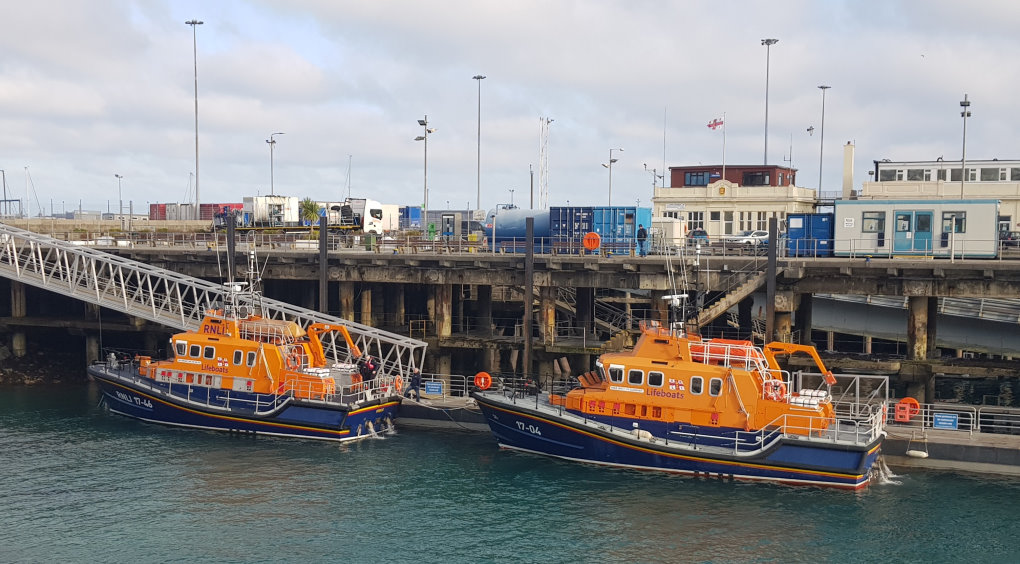
The Margaret Joan and Fred Nye 17-46 arrived today to cover for the St Peter Port lifeboat.
Our lifeboat is going back to Poole for some essential engine maintenance. The last time Margaret Joan and Fred Nye was in Guernsey was in 2009.
St Peter Port Coxswain remembers the gold medal RNLI rescue on 40th Anniversary
On the 40th anniversary of one the RNLI’s most memorable rescues, the former Coxswain of the St Peter Port lifeboat Sir William Arnold has spoken about the night he and his volunteer crew faced hurricane conditions to save the crew and passengers of an 8,000-tonne Ecuadorian cargo ship in the English Channel.
On 13 December 1981, volunteer crew from St Peter Port RNLI Lifeboat Station on Guernsey launched to the rescue of Bonita; an Ecuadorian cargo ship loaded with fertiliser, sailing from Hamburg to Panama, caught in a hurricane in the English Channel.
See https://www.facebook.com/stpeterportlifeboat/videos/445434613695678 for the video
The Bonita had 36 people aboard: Ecuadorian crew members plus engineers and an electrician from Spain and Norway. The Captain and the First Engineer had also welcomed both their wives and children aboard.
The huge waves that were lashing against the Bonita’s port side caused her to list heavily to starboard which shifted the ship’s cargo. She was soon unable to right herself and the ship’s engine lost power.
The RNLI’s volunteers on St Peter Port’s Sir William Arnold lifeboat launched to the cargo ship at 1.23pm after learning the Bonita’s Captain had put out a mayday alert.
Michael Scales, St Peter Port Lifeboat Coxswain at the time, recalls the conditions;
‘Well, that morning was quite horrendous, St Peter Port harbour was closed. We got a call about 1pm, roughly lunchtime, we hadn’t had our lunch yet by the way. St Peter Port had received a mayday, off we set. Shortly after leaving St Peter Port, we broached (keeled over to one side by the force of the wind and sea), and that was the first of many broachings. On the radar, you could just see walls of water.’
Meanwhile, a Royal Navy rescue helicopter had headed to the scene and successfully managed to take four people, including the Captain’s wife and toddler, off the Bonita. However, the helicopter’s rotor blades started to ice up, forcing the aircraft crew to retreat.
Battling 15m waves, the lifeboat crew arrived on scene to find the Bonita now listing at 45°. Despite the shrieking winds around them, the lifeboat volunteers managed to usher the Bonita crew towards the stern of the ship.
Michael continues;
‘The first view of the ship, it was dusk, it’s snowing, the seas were 15 metres high. It’s not until you see the daunting sight of a ship laying on its side knowing the amount of people that have to be rescued and the precarious position they are in, then you have a thought ‘well, how am I going to get these off safely, or as best you can.’
Aboard the Bonita, shock, panic and exhaustion were beginning to take over. Two crew members, including the Second Engineer, had broken legs. Michael Scales brought the lifeboat’s bow alongside the ship and two men successfully jumped aboard from the stern.
Unexpectedly, a third man jumped from the Bonita and mistimed his leap, falling head-first onto the lifeboat and sustaining a serious head injury. He was carried into the wheelhouse where Mechanic Bob Vowles administered first aid.
Following this, Michael was concerned that further attempts would risk all those involved. The new plan was to approach the Bonita head-on and throw a line, so people could attach it to themselves and jump into the sea. The RNLI volunteers could then pull them aboard, to safety.
‘I had great respect for those crew members onboard Bonita who decided ‘well we’re going to jump’ because personally I wouldn’t have liked to.
‘I wasn’t thinking about my state of mind, I was thinking about the state of mind of the people we had to persuade to jump.’
The plan would require great teamwork and boat-handling skills to work. The First Engineer’s wife and two daughters were the first to be pulled aboard but not all the transfers went so smoothly.
Whilst attempting to reach the Sir William Arnold, a man let go of the line after jumping into the sea and had to be pulled aboard by the lifeboat crew. He had stopped breathing but was soon resuscitated by the crew.
Several rescue helicopters were now on scene, but the conditions were too challenging to safely rescue those onboard the Bonita. The Second Engineer, who had broken both his legs, could not make it to the lifeboat. After three attempts, a rescue helicopter managed to hover low enough to secure the injured man and airlift him to hospital.
‘Halfway through, we had 16 people on board, we had a serious injury and the crew were exhausted. I was exhausted because it is concentration. Eventually the master of the Bonita was rescued and then I went ‘oh, thank you God!’.’
Although they had finally reached the safety of the lifeboat’s wheelhouse, the survivors were not home and dry just yet. In total, the RNLI volunteers rescued 29 people, who were then taken to Torbay Lifeboat Station. The lifeboat, her crew and all the casualties of the Bonita reached Devon at 11.13pm, after more than 10 hours at sea.
Sadly, two Bonita crew members were lost during the rescue. The first crew member’s life was lost after he fell and hit the side of the ship during the rescue, killing him instantly. Tragically, the man who had suffered a head wound jumping onto the lifeboat later died in hospital due to his injuries.
In May 1982, the St Peter Port crew attended the RNLI’s Annual Presentation of Awards. Coxswain Michael Scales received a Gold medal for Gallantry while his crew all received a Bronze.
Six days after the Bonita rescue, on 19 December 1981, the Penlee lifeboat crew launched to a coaster, Union Star, which was battling hurricane winds. The crews of both vessels were all lost. It was the worst lifeboat tragedy in living memory.
‘We were at there at the same time as the widows of Penlee receiving their husbands’ or sons’ medals. We took our [RNLI] ties and tied them in a big knot and presented them to the widows as a knot of friendship between the stations.’
This year, Penlee Lifeboat Station marked the event’s 40th anniversary with a flotilla of lifeboats and lay wreaths in memory of the 16 lives lost.
The Sir William Arnold now serves as a floating classroom and museum in London. Owner Colin Trowles restored the lifeboat in hopes to teach visitors about the RNLI and its courageous volunteers.
Michael reflects on the past 40 years, saying; ‘I look at some of the photos, a few of my crew have since passed. I look at 40 years and think, ‘where did that go.’
‘I look at what the RNLI is doing now in their construction, their training, the college and it’s a new generation, but it’s still get out there and save lives.’
This Christmas, many RNLI volunteers will leave their loved ones behind to answer the call, but these rescues would not be possible without donations from the RNLI’s generous supporters.